Versatile and cost-effective.
The stationary pallet changer is mainly used in industries where some products, i.e. liquids, cannot be inverted as this would cause problems with validation or in industries where goods are packed in fragile packaging materials. The pallet changer is often placed within a receiving area where inbound goods can quickly be transferred to in-house pallets, typically plastic or aluminum pallets, and the wooden pallets can then be isolated from the rest of the facility.
Features compared to pallet inverters:
- Improved handling speed
- No clamping of goods
- No inversion of load
- Simple construction
- Less maintenance because of no rotation parts
- Speed reduction for end positions
- Remote controlled
Options:
- Remote controlled
- Stainless steel construction
- Can be transported in four separate components
For single stacked goods like Octabins, FIBCs etc. the stationary pallet changer can also push the product onto the mechanical ROLLERFORKS®. When standard counterbalanced lift trucks are too heavy for the container/trailer floor a ROLLERFORKS®-LIFTER can be used as an alternative.
Transferring goods from one load carrier to another
Transferring goods on a slip sheet attachment
Visit the manufacturer website:

Visit the MSE You Tube channel:

MSE Load Push Attachment
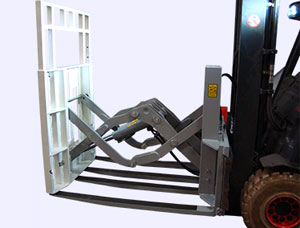
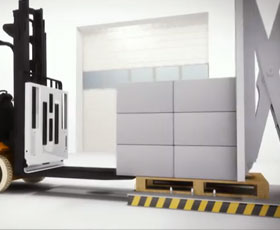
A Load Push Attachment is a heavy-duty variation of the standard unit and is primarily designed for use in combination with a stationary pallet inverter or pallet changer. It is used to push unit loads without pallets or slip sheets into containers or trailers.
The Load Push Attachment is designed for heavy use under harsh conditions. Non-slipsheeted goods can be pushed into position with brute force against other loads in order to create straight positioning and to optimize space inside sea containers.
The heavy duty load push attachment has the following features:
- Laser cut components resulting in less own weight
- Made of special steel for a strong construction
- Heavy duty components like mast profile, mast roller and robust cylinders
- One hydraulic function required
Originally the load push attachment was designed for the cement industry, but it is also well suited for pushing bagged goods (like soy bean seeds) and boxed goods (like fish or meat) into the container.